
Our High School Academic Curriculum
Empowering Students Through Personalized Learning
At ThrivePoint High School, we believe that every student deserves an education that adapts to their unique needs, goals, and pace. Our curriculum is built around flexibility, relevance, and support—giving students the freedom to learn in a way that works best for them. Whether a student is aiming for college, a career, or simply a high school diploma, our courses are designed to provide a strong academic foundation while also encouraging exploration and growth.
We offer a wide range of courses that meet Arizona state standards, including core subjects, electives, and career-focused pathways. Our online and in-person learning options allow students to progress at their own speed, with the guidance of certified teachers and dedicated Student Success Coaches. From credit recovery to accelerated learning, ThrivePoint’s curriculum is tailored to help students succeed—no matter where they’re starting from.
Explore Our Course to Offerings
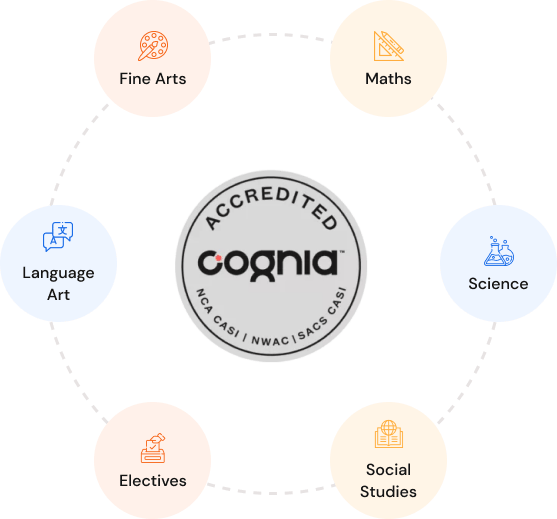
Navigate Subjects by Category
Use the table below to browse ThrivePoint’s available classes by subject area. From core academics to electives and career pathways, our curriculum is designed to support every learner’s goals.
Check Out Our Language Arts
Language Arts equips students with the essential tools of communication; reading, writing, speaking, and listening. Through literature study, learners explore diverse voices, themes, and cultures while developing critical thinking and analytical skills. Writing assignments allow students to practice clear expression, persuasive argumentation, and creative storytelling, helping them find their own voice and style. In addition, public speaking and presentation activities build confidence and prepare students to communicate effectively in academic, professional, and social settings. By engaging with novels, poetry, essays, and multimedia texts, students not only strengthen grammar and vocabulary but also gain an appreciation for the power of language to shape ideas, inspire change, and connect people.

English 1
English 1
CAMPUS, ONLINE, SUMMER, PART-TIME
English 1A and 1B
Fulfills University Requirements
English 1 launches a four-year journey to prepare students for college-level language arts skills. Students practice reading, writing, and editing to prepare for formal exams and tests as well as for their future careers. In this course, students analyze various classics, such as The Odyssey and Romeo and Juliet. The course requires students to obtain and read two other books to understand plot development and the structure and organization of longer texts. To help students in their activities, assignments provide specific genre models, outlines, and rubrics. For example, the step-by-step method of writing a research paper guides students to create a polished paper with MLA citations. Also, opportunities to discuss, present, and interact assist students in their listening and speaking skills.
English 2
English 2
CAMPUS, ONLINE, SUMMER, PART-TIME
English 2A and 2B
Fulfills University Requirements
English II begins with a review of the fundamentals of grammar, reading, and essay writing that began in English I. Students then move on to more complex tasks, such as analyzing a book of their choice and writing for various genres. The course expands students’ vocabulary through word study and analyzing context in diverse literary and informative texts. Students dig into the purposes of language in persuasive media and political texts. Additionally, the formal research paper is adapted into a multimedia presentation. The last two Units of the course move from analyzing classical literature to a book study, opening a discussion of various relevant cultural issues in modern society.
English 3
English 3
CAMPUS, ONLINE, SUMMER, PART-TIME
English 3A and 3B
Fulfills University Requirements
In English III, students will focus on the development of American Literature and compare it with other ideas and forms of literature from around the world. Students will review the basics of the language arts and scaffold each with practices of increasing complexity to meet the required grade-level objectives of analytical thinking. Engaging in a step-by-step process, students will learn to write complex analyses and argumentative papers. Students will also learn principles in research, teamwork, discussion, and presentation.
The text that should accompany the course is the musical Fiddler on the Roof by Joseph Stein. Students will highlight literary devices as well as the ideas of immigration and cultural assimilation with supporting literature. Additionally, students will explore college and career planning and learn tips for discerning factual information in technology today.
English 4
English 4
CAMPUS, ONLINE, SUMMER, PART-TIME
English 4A and 4B
Fulfills University Requirements
English IV emphasizes the interpretation of various types of literature from different time periods. The genres covered include fiction, drama, and poetry. The dramatic play Cyrano de Bergerac is read and studied for its use of language to convey dilemmas and themes. Poetry studies include a survey of British poetry as well as ancient and modern poetry from various cultures and periods. Students are also given a wide range of writing assignments. For example, students produce a fiction story and a script. They also write essays evaluating literary elements. The course also includes research and writing arguments with logic. These various writing assignments help prepare students for end-of-course and SAT essay writing. Coverage is also given to analyzing and evaluating media and speeches, as well as using presentation and discussion skills.
Literary Genres
Literary Genres
CAMPUS, ONLINE, SUMMER, PART-TIME
Literary Genres A and B
May be used in place of English 4A and/or 4B for personal curriculum for non-university bound students OR as electives
Literary Genres is a senior-level course in which students explore and analyze a variety of literature. A grammar review precedes a study of rhetorical and literary devices, as well as a brief survey of the major literary forms. Students read a variety of fictional selections and stories, including The Canterbury Tales, various mythologies, Beowulf, Hansel and Gretel, Dracula, and Edgar Allan Poe’s “The Masque of the Red Death.” The course helps students better understand drama after reading excerpts from William Shakespeare’s plays and will contemplate timeless poems by Robert Frost, Emily Dickinson, Walt Whitman, Lord Byron, and other poets. Comparing and contrasting speeches by Barack Obama and Ronald Reagan assists students in analyzing persuasive texts. The course concludes with a look at perspective in nonfiction texts, such as diaries and autobiographies.
Speech Communication
Speech Communication
CAMPUS, ONLINE, SUMMER, PART-TIME
May be used in place of English 4A and/or 4B for personal curriculum for non-university bound students OR as electives
Speech Communication seeks to improve the interpersonal and public communication skills of students. Surveying the communication process, students will learn the components and functions of communication, differentiate between oral and nonverbal communication, and comprehend the listening process. Developing familiarity with self and personal strengths and weaknesses, students will boost self-confidence as public speakers in situations such as speeches or interviews. The course will culminate with students applying their acquired communication skills in researching, preparing, and giving a speech.
Web Communication
Web Communication
CAMPUS, ONLINE, SUMMER, PART-TIME
May be used in place of English 4A and/or 4B for personal curriculum for non-university bound students OR as electives
In Web Communications, students learn how to be good digital citizens. Rights, responsibilities, and digital communication tools are explored. Students learn how to search and choose valid internet sources for research while gaining a deeper understanding of new technologies. Students dive into the history of the Web and how it has changed over time. Topics such as internet safety, security, and cyberbullying are also analyzed. Using the knowledge gained in the course, students write a web-hosted blog post with HTML coding elements. The course ends with the fundamentals of web design and a project in which students create a simple webpage.
Check Out Our Mathematics
Mathematics is more than just numbers, it’s the universal language of logic, reasoning, and problem-solving. In this subject, students develop a deep understanding of concepts ranging from foundational arithmetic to advanced topics such as algebra, geometry, trigonometry, statistics, and calculus. Mathematics builds essential life skills like financial literacy, logical decision-making, and technological problem-solving, preparing students for success in higher education, careers in science and technology, and everyday challenges. Whether exploring the elegance of geometric shapes, the power of equations, or the usefulness of probability, students will gain both confidence and curiosity in applying math to their world.
Algebra 1
Algebra 1
CAMPUS, ONLINE, SUMMER, PART-TIME
Algebra 1A and 1B
Fulfills University Requirements
Algebra 1 is a common starting point for high school math studies. A review of fundamental math skills in Unit 1 ensures students are ready for algebraic concepts. Math competence grows as students learn to solve expressions, equations, and inequalities using formulas, ratios, proportions, percentages, and rates. Other concepts covered include identifying functions, understanding patterns and sequences, solving direct and inverse variation, memorizing slope formulas, writing and graphing linear equations, and learning systems of equation and inequality. The course covers exponent rules to work and solve exponential functions, operations with polynomials to solve quadratic functions and equations, and the various methods to graph, factor, simplify square roots, complete the square, and use the quadratic formula. Using tables and graphs, students analyze and organize data and statistics using linear, quadratic, and exponential models. The standard assessment questions throughout the course help the students complete the course successfully and prepare for new concepts in Geometry.
Geometry
Geometry
CAMPUS, ONLINE, SUMMER, PART-TIME
Geometry A and B
Fulfills University Requirements
High School Geometry deals primarily with two-dimensional Euclidean geometry and solid geometry, promotes development of logical reasoning skills, and is useful in many life situations. The course begins with the fundamental concepts of line segments and angles. Students progress to conditional statements, geometric and algebraic proofs, and line relationships. In studying polygons, students learn the properties of triangles, quadrilaterals, and circles, along with geometrical concepts, including the Pythagorean Theorem and the relationship of pi (p) to the circumference and area of a circle. In the study of solid geometry, students learn how to determine area and volume for prisms, cylinders, pyramids, cones, and spheres. Students apply the geometric skills learned working with ratios, similarities, transformations, and symmetry before concluding the course with an inquiry into the fundamentals of trigonometry.
Algebra 2
Algebra 2
CAMPUS, ONLINE, SUMMER, PART-TIME
Algebra 2A and 2B
Fulfills University Requirements
Algebra 2, students will consolidate and build on knowledge acquired in Algebra I. After a review of Algebra I concepts, students will take an in-depth look at linear equations, inequalities, and functions. Students will be introduced to matrices, apply Cramer’s Rule in solving linear systems, and solve graphs and equations of conic sections. Using graphs, factoring, and the quadratic formula, students will solve quadratic equations, inequalities, and functions. Students will investigate how to graph, factor, invert, and solve polynomials; and they will solve rational expressions, radical expressions, fractional exponents, and rational inequalities. Students will examine the properties, transformations and applications of exponential and logarithmic functions. Applying probability and data analysis, students will determine probability and model data. The final Unit will present trigonometric concepts to prepare students advancing to trigonometry
Precalculus
Precalculus
CAMPUS, ONLINE, SUMMER, PART-TIME
Precalculus A and B
Fulfills University Requirements
Precalculus explores a wide variety of mathematical concepts with the goal of preparing students for calculus or other college-level math courses. A review of numerical properties, factoring, the quadratic formula, and the Cartesian coordinate system prepares students for advanced mathematical concepts. Students use graphing calculators to plot graphs and solve equations and learn to solve a variety of problems including parent functions, transformations, even and odd functions, domain and range, operations, linear functions, regression, correlation, quadratic functions, polynomials, asymptotes, and exponential, logistic, and logarithmic functions. Trigonometric studies include angle measurement, arc length, functions, reciprocal and quotient identities, Pythagorean identities, sines, and cosines. Sequences and series precede inquiries into the characteristics and applications of conic sections and vectors. The course concludes with an investigation into parametric and polar equations.
Trigonometry
Trigonometry
CAMPUS, ONLINE, SUMMER, PART-TIME
Trigonometry A and B
This course focuses on trigonometric principles as an extension of algebraic and geometrical concepts. Students will study angles, arcs, the unit circle, right triangle trigonometry, the six trig functions, inverse functions, fundamental trig identities, verifying trig identities, solving trig equations, the law of sines, the law of cosines, vectors, complex numbers, and polar coordinates.
Math Models
Math Models
CAMPUS, ONLINE, SUMMER, PART-TIME
Math Models A and B
May be used in place of Algebra 2A and/or 2B for personal curriculum for non-university bound students or electives
The Math Models course applies mathematical concepts to real-life situations. The course begins with a review of basic mathematical concepts before presenting an overview of geometry, probability and statistics, and problem solving. The course teaches students to conduct and analyze research by collecting and describing data. Data is described using graphs and models that find application in disciplines as diverse as science, trigonometry, art, architecture, and music. Students employ theoretical, empirical, and binomial probability to predict the likelihood of outcomes. Math Models allows students to better understand personal finance issues including compensation, budgeting, taxes, bank accounts, and compound interest. Applying math models to analyze the pros and cons of credit cards, renting or purchasing a home, leasing or purchasing a vehicle, and investments and insurance enables students to become smarter consumers.
Personal Finance
Personal Finance
CAMPUS, ONLINE, SUMMER, PART-TIME
Personal Finance A and B
May be used in place of Algebra 2A and/or 2B for personal curriculum for non-university bound students or electives
We all know money is essential in life, and the financial decisions you make today may have a lasting effect on your future. Explore how to spend and save your money wisely, and learn key financial concepts around taxes, credit, and money management. Discover how education, career choices, and financial planning can lead you in the right direction to making your life simpler, steadier, and more enjoyable.
Check Out Our Science
Science invites students to explore the natural and physical world with curiosity and discovery. Through subjects such as biology, chemistry, physics, and environmental studies, learners investigate how life functions, how matter behaves, and how the universe operates. Students will study living organisms and ecosystems, examine the building blocks of matter, experiment with forces and energy, and evaluate the impact of human activity on the planet. By engaging in hands-on experiments, critical thinking, and inquiry-based learning, students develop not only scientific knowledge but also problem-solving, observation, and analytical skills. Science equips learners with the tools to understand and appreciate the world around them while inspiring innovation and responsible decision-making for the future.
Biology
Biology
CAMPUS, ONLINE, SUMMER, PART-TIME
Biology A and B
Fulfills University Requirements
In Biology, students develop an appreciation for the living world. A brief history of biology followed by an investigation of the basic unit of life—the cell—prepares students for deeper research. Students explore topics concerning genetics, including meiosis, heredity, and DNA. Students consider natural selection, origin of life theories, and the mechanics of evolution. An exploration of “little critters” such as bacteria precedes a study of plant structures, processes, and reproduction. Students inquire into animal behavior and characteristics as they study invertebrates, amphibians, reptiles, birds, and mammals, among others. An inspection of nutrition and disease leads students to examine human body systems. The course concludes with an analysis of the interdependence of living things in ecosystems.
Chemistry
Chemistry
CAMPUS, ONLINE, SUMMER, PART-TIME
Chemistry A and B
Fulfills University Requirements
A foundational branch of physical science, the principles and laws of chemistry find many applications in business, technology, health care, and other fields outside traditional scientific areas. Beginning with a look at measurements, calculations, data analysis, and the scientific method, students investigate the properties of elements, compounds, and mixtures. A survey of the history of theories of atomic structure leads students to Mendeléev’s periodic table and an inspection of periodic law. Next, students apply atomic theory in the study of molecular and chemical bonding interactions through chemical formulas, reactions, and stoichiometry. Students’ knowledge expands as they learn about the states of matter, gas laws, solutions, acids and bases, thermochemistry and reaction kinetics, and oxidation-reduction reactions. The course concludes with inquiries into organic chemistry, biochemistry, and nuclear chemistry. Throughout the course, there are lab investigations, including video labs, to reinforce scientific concepts and skills.
Earth Science
Earth Science
CAMPUS, ONLINE, SUMMER, PART-TIME
Earth Science A and B
Fulfills University Requirements
Earth Science is the study of the very ground beneath your feet and what’s below that—all the way to the core. Your exploration of the Earth begins with the formation of the universe and how our glorious blue rock became the home we have today. You will dive into the nature of the stars and how they form the building blocks of our planet. From there you’ll journey through the development of our Earth and see how past events can help us understand our present. The forces that made the Earth impact our lives on a daily basis.
Once you know about the world you call home, Earth Science B is your introduction into how we take care of it. This course takes a look at the resources that populate the spheres (biosphere, atmosphere, geosphere, hydrosphere, and cryosphere). It looks at how we use those resources, renew them, deplete them, and waste them. Earth Science B covers topics that help you be a good citizen of the Earth.
Physics
Physics
CAMPUS, ONLINE, SUMMER, PART-TIME
Physics A and B
Fulfills University Requirements
In Physics, students will learn concepts, including matter and energy, motion and force, speed, velocity, and acceleration in order to better understand how the universe behaves. A survey of the historical development of physics as a foundational branch of science will lead to recognition of the contributions of Newton, Einstein, Planck, and others. Students will apply physics concepts as they study gravity and acceleration, momentum, motion, and energy. The concepts of work and power will become evident as students learn how machines use torque and force to accomplish work. Students will recognize the roles of each fundamental force and will investigate electrostatics, thermodynamics, wave forms, particles, and quantum physics. Following an examination of the nucleus, radioactivity, fission, and fusion, the course will conclude with the theories of special and general relativity. Throughout the course, there will be investigations, including video labs, to reinforce scientific concepts and skills.
Anatomy and Physiology
Anatomy and Physiology
CAMPUS, ONLINE, SUMMER, PART-TIME
Anatomy and Physiology A and B
May be used for non-university bound students
Anatomy and Physiology introduces students to the structures and functions of the amazing body. Students learn about different organ systems and how they work together to maintain life. Some of these organ systems include the circulatory, digestive, integumentary reproductive, and respiratory systems. Students examine different diseases that affect these systems and the treatments (both traditional and new) used to fight these diseases. The development and effects of aging on the different organ systems are explored throughout Anatomy and Physiology.
Aquatic Science
Aquatic Science
CAMPUS, ONLINE, SUMMER, PART-TIME
Aquatic Science A and B
May be used for non-university bound students
In Aquatic Science, students will test, predict, and learn about water and things pertaining to water. The first Unit will guide students to think of water as a system. Learning the chemistry and physics of water, students will complete a course Project by applying scientific methods to collect and analyze data on a local body of water. A survey of the physical properties of the ocean, including its formation and composition, will precede an inquiry into how the atmosphere and Sun interact with the hydrosphere to create weather. Students will examine the elements and properties of aquatic ecosystems, including aquatic biology and marine and freshwater ecosystems. In the final Unit, students will consider the relationship between humans and water, including challenges such as population growth competing for resources with agriculture and industry
Astronomy
Astronomy
CAMPUS, ONLINE, SUMMER, PART-TIME
Astronomy A and B
May be used for non-university bound students.
Beginning with a look at astronomy’s history, students will recognize the contributions of Ptolemy, Copernicus, Galileo, and Newton to humankind’s understanding of the universe. The second Unit investigates telescopes and detectors, including radio receivers. Examining the characteristics and processes of the Sun will be followed by a look at the terrestrial planets: Mercury, Venus, and Mars. After studying the Earth-Moon system, students will explore facts about the minor planets, Jupiter, Saturn, and the outer planets. Moving beyond the solar system, students will learn the characteristics of stars, galaxies, and other deep space objects. Students will better appreciate the night sky after learning the constellations and discover the origin and fate of the universe with an inquiry into impermanence, special and general relativity, and cosmology.
Environmental Science
Environmental Science
CAMPUS, ONLINE, SUMMER, PART-TIME
Environmental Science A and B
May be used for non-university bound students.
In Environmental Science, students will learn about different Earth systems, how they interact with each other, and how humans impact these systems. Students will look at the scientific bases for land, water, atmosphere, and biosphere systems; discuss several environmental problems; analyze possible solutions; delve into laws already in existence; and discuss any possible future laws. Critical thinking will be required, as well as the ability to argue points from both sides of an issue. Throughout the course, there will be lab investigations, including video labs, to reinforce scientific concepts and skills.
Forensic Science
Forensic Science
CAMPUS, ONLINE, SUMMER, PART-TIME
Forensic Science A and B
May be used for non-university bound students.
In Forensic Science, students discover the history of forensic science and how this career field has evolved over time. Students begin their study with a survey of forensic science career subspecialties, and their roles in helping to solve crimes. Students discuss the types of criminal evidence that forensic investigators often encounter at a crime scene, as well as how to collect, handle, and process that evidence. Students will explore examples ranging from bloodstains, DNA, impressions, fingerprints, and hair and nails, to evidence gathered by anthropological analysis and ballistics. Students equip themselves with opportunities to use scientific and law-based methods to analyze criminal evidence throughout this course. Students draft toxicology reports and perform other forensic activities to practice the art of preserving criminal evidence. The course concludes with a demonstration of the forensic importance of questioned documents, and a peek into the future of forensics.
Integrated Physics and Chemistry
Integrated Physics and Chemistry
CAMPUS, ONLINE, SUMMER, PART-TIME
Integrated Physics and Chemistry A and B
May be used for non-university bound students.
In Integrated Physics and Chemistry (IPC), students will learn many fascinating chemistry and physics concepts. Students will have a brief introduction to the scientific method, lab safety, and the metric system. The study of chemistry will begin with atomic theory and the Periodic Table, applying theory to develop chemical formulas and balance equations. The course will include investigations into acids and bases, gas laws, and nuclear chemistry. Students will explore Newton’s laws of motion and other physics concepts including mass, force, motion, velocity, acceleration, gravity, and energy. A study of electricity and magnetism, simple machines, the laws of thermodynamics, and energy waves will round out the physics portion of the course. Throughout the course, students will perform lab investigations, including video labs, to reinforce scientific concepts and skills.
Medical Microbiology
Medical Microbiology
CAMPUS, ONLINE, SUMMER, PART-TIME
Medical Microbiology A and B
May be used for non-university bound students.
Medical Microbiology explores the world of tiny (micro) organisms that are responsible for making people sick. Students learn about the common bacteria, viruses, and protists that cause sickness and disease in humans. Medical Microbiology delves into different ways these germs and diseases can spread from person to person, throughout a community, and eventually around the globe while discussing the best practices for stopping them from spreading. Students look into different medications and how they work to kill or slow the growth of different microorganisms. Students will also research why some antibiotic medications are no longer effective against the bacteria that cause disease. Medical microbiology also teaches laboratory skills in how to effectively grow and isolate different colonies of microorganisms in Petri dishes.
Medical Terminology
Medical Terminology
CAMPUS, ONLINE, SUMMER, PART-TIME
Medical Terminology A and B
May be used for non-university bound students.
Medical Terminology is a course for students with an interest in the medical field. This course provides students with knowledge of Latin and Greek roots, prefixes, and suffixes in addition to combining forms and eponymous terms related to the many systems of the human body. Students are also able to learn more about the many professions, specialists, and treatment plans associated with different areas of the body. This course introduces new ways of looking at the body through the lens of medical terms and their origins.
Check Out Our History & Social Studies
History and Social Studies helps students understand the complexity of human societies, cultures, and historical events that have shaped the world we live in today. By studying history, geography, civics, and economics, learners gain insight into how people, places, and ideas connect across time. Students explore ancient civilizations, landmark events, and influential leaders, while also examining modern social issues, government structures, and global interactions. This subject encourages critical thinking, empathy, and cultural awareness by analyzing multiple perspectives and understanding cause-and-effect relationships throughout history. Through Social Studies, students not only learn about the past but also develop the knowledge and civic responsibility needed to actively contribute to their communities and the world’s future.

World History
World History
CAMPUS, ONLINE, SUMMER, PART-TIME
World History A and B
Fulfills University Requirements
World History is a survey of the development of civilizations from prehistoric times to the present. The journey begins with ancient civilizations including Mesopotamia, Egypt, and China, and the foundations of western civilization: ancient Greece and Rome. Students analyze developments in Africa, Asia, and Europe during the Middle Ages, including the Crusades. This course covers how the Renaissance and Reformation provided a springboard for the Age of Reason and the Scientific Revolution. An inquiry into events such as the American War of Independence and French Revolution prepare students to consider the great advances and social upheaval sparked by the Industrial Revolution. Units probe the causes, events, and consequences of the two World Wars and the rise and fall of Communism. The course concludes with a look at developments shaping current events.
United States History
United States History
CAMPUS, ONLINE, SUMMER, PART-TIME
United States History A and B
Fulfills University Requirements
U.S. History Since 1877 details the American story from the Reconstruction to the present day. Beginning with western expansion, students analyze the impact of events including the rise of cities and capitalism, the Alaska Purchase, and the Spanish-American War. The course details technological advances including the assembly line and harnessing electricity, as well as societal reform. Students then discuss how this progress influenced American prosperity. Students consider America’s rise to a world power during World War I before probing the events leading up to World War II, including the Great Depression. Students examine World War II and its consequences, including the Cold War and Korean War. The course then moves to 20th century events, including the Reagan era and the Persian Gulf War, concluding with a look at recent events, including the War on Terrorism.
United States Government
United States Government
CAMPUS, ONLINE, SUMMER, PART-TIME
Fulfills University Requirements
U.S. Government commences its examination of American democracy with a general overview of the purpose, types, origin, and formation of governments. Students explore how colonial self-rule, English law, and weaknesses in the Articles of Confederation influenced the formation of the U.S. Constitution. Students then investigate the principles of the Constitution and the federal system. The purpose, powers, and relationships among the American institutions of self-government—Congress, the Presidency, and the Judiciary—are examined as well as federal, state, and local governments. Students learn about civic responsibility, including voting and participating in the governmental process. They gain an understanding of the functions and organization of political parties, the evolution of the two-party system, and the influence of public opinion and political ideology on government decisions.
Economics
Economics
CAMPUS, ONLINE, SUMMER, PART-TIME
Fulfills University Requirements
The Economics course begins with a survey of the basic principles concerning production, consumption, and distribution of goods and services within the free enterprise system. Students examine the rights and responsibilities of consumers and businesses; analyze the interaction of supply, demand, and price; and study the role of financial institutions. Types of business ownership, market structures, and basic concepts of consumer economics are surveyed. The impact of a variety of factors including geography, governmental intervention, economic philosophies, historic documents, societal values, scientific discoveries and technological innovations on the national economy, and economic policy are an integral part of the course. Students apply critical-thinking skills when creating economic models and evaluating economic activity patterns. Students also examine the knowledge and skills necessary for self-supporting adults to make critical decisions relating to personal financial matters, such as seeking college financial aid, using credit wisely, and balancing financial accounts.
Check Out Our Fine Arts
Art provides students with opportunities to express themselves creatively while developing important skills in communication, imagination, and self-discovery. Through visual arts, music, theater, and design, learners explore different forms of artistic expression and discover their unique creative voice. Students may experiment with painting, drawing, sculpture, or digital media, while also experiencing the power of performance through acting, singing, or playing instruments. Art education fosters an appreciation for culture and aesthetics, encourages innovative thinking, and builds confidence through creative problem-solving. Beyond creating, students also learn to interpret and appreciate the work of others, gaining a deeper understanding of the role art plays in shaping societies and connecting people across cultures.

Art History
Art History
CAMPUS, ONLINE, SUMMER, PART-TIME
Art History A and B
Art History will help students develop skills to recognize and appreciate the diversity of art. The course begins with prehistoric and ancient art before introducing students to the classical art of the Greeks and Romans. Students will survey medieval art before exploring the glory days of art and architecture, the Renaissance. The use of light and shadow to evoke emotion during the Baroque period will impress students as will the whimsical style of the Rococo period. Students will contrast the Neoclassical return to idealized subjects with the Romantic era’s imagination. Appreciation of art will grow as students study Impressionist and Post-Impressionist artists such as Monet and Van Gogh. The course concludes with students tracing modern art movements, including expressionism, minimalism, as well as conceptual art and artists, including Rodin, Picasso, Mondrian, and O’Keeffe.
Audio/Video Production
Audio/Video Production
CAMPUS, ONLINE, SUMMER, PART-TIME
Audio/Video Production 1A and 1B
Audio/Video Production I explores foundational principles in both audio design and video production. This course is broken down into four primary sections: pre production, principal photography, post production, and career preparation/portfolio development. Each section focuses on the primary elements found in each phase of production. Preproduction explores topics, such as script and storyboard development, production documents, and production planning. Principal photography analyzes key crew roles associated with audio and video production, like the director, sound designer, producer, and actors, as well as shooting techniques, camera gear, and on-set safety. Postproduction delves into topics, such as video editing, copyright laws, and sound mixing and design. The course concludes by having the student create an audio/video portfolio, resumé, and cover letter to prepare for entry into college and the professional world.
Graphic Design & Illustration I
Graphic Design & Illustration I
CAMPUS, ONLINE, SUMMER, PART-TIME
Graphic Design & Illustration 1A and 1B
Graphic Design and Illustration I is an introductory course that explores the elements, principles, and tools of the graphic design and illustration industries. Students begin the course by analyzing the various elements of design such as color, shape, and value and applying them to unique works of their own. Personal projects include product label design, logo design, figure drawing, designing type, and more. The course focuses on design tool basics such as software applications and computer hardware. The student will practice design skills directly on computer applications while exploring other key professional skills such as creating design proposals, typography, cyber security, printing, copyright laws, artist critiques, and other career tools. The course concludes by having students assemble a graphic design and illustration portfolio. Their portfolio can be used for art school applications, job placement, or general professional development.
Graphic Design & Illustration II
Graphic Design & Illustration II
CAMPUS, ONLINE, SUMMER, PART-TIME
Graphic Design & Illustration 2A and 2B
Graphic Design and Illustration II builds on the visual concepts explored in Graphic Design and Illustration I. Students take a deeper analysis into design concepts and equip themselves with new Projects and design application training opportunities. Students reexamine design principles and elements, effective color use, typography, and design for campaigns and products. Students practice designing promotional materials, product labels, and architectural illustration, as well as designing for a local nonprofit and exploring cybersecurity principles. Students prepare for employability by building a personal promotional website, portfolio, résumé, and cover letter. The course concludes with combining these materials to complete an industry-related job application.
Music Appreciation
Music Appreciation
CAMPUS, ONLINE, SUMMER, PART-TIME
Music Appreciation A and B
This course is designed to help the non-musician understand music basics, including such topics as reading a musical score, melody and harmony, rhythm, music history (styles by period), music theory, musical genres, instruments, orchestration, and arrangement. The course even covers the creation of musical scores using popular music arrangement software. Other topics include the science of musical sound, health and wellness for performers, classical symphony concerts, and etiquette when attending. The course strives to help non-musicians gain an understanding of the world of music and become well-rounded individuals.
Video Game Design
Video Game Design
CAMPUS, ONLINE, SUMMER, PART-TIME
Video Game Design is a course designed to help students develop skills for planning, designing, and completing development of an original video game. These skills include outlining and writing a game story, storyboarding, level and objectives design, game mechanics, and character design. Students are also exposed to development skills, including use of pseudocode, decisions, algorithms, collisions, and other programming functions, as well as graphics, animation, and sound. The student will become familiar with the use of suitable game engines for creating their working video game. The course includes discussion to help the student understand the history of video games, as well as their genres. This includes discussions of game theory to help students understand audience expectations, control, and other aspects of game design. Students will be required to create an original video game and submit it for critique. In addition, students will be involved in playing and critiquing the games of other students, as well as critiquing existing video games. The student will be required to create and understand the purpose of a Game Design Document
Check Out Our Career & Technical Education
Career and Technical Education prepares students for the real world by combining classroom learning with hands-on experience. Through pathways in business, health sciences, information technology, engineering, and other specialized fields, students gain practical knowledge and career-ready skills. CTE courses emphasize problem-solving, teamwork, and technical expertise, allowing learners to explore their interests while building a strong foundation for future success. Whether mastering computer applications, learning about medical practices, developing leadership skills, or exploring entrepreneurship, students are equipped with the tools to thrive in both higher education and the workforce. Career and Technical Education bridges the gap between academics and professional life, empowering students to turn their passions into meaningful career opportunities.

Accounting
Accounting
CAMPUS, ONLINE, SUMMER, PART-TIME
Accounting A and B
In the Accounting I Jump Course for high school, students will learn a basic overview of the different functions in accounting. This includes rules for financial reporting and the parts of the balance sheet, income statement, and statement of stockholders’ equity and retained earnings. Students will then be guided through the accounting cycle, learning how to create these documents and utilize them within a corporation. Students will journalize payments and invoices in accounts payable and accounts receivable, understand the different methods of inventory, and calculate payroll and taxes. Students will complete the course with the Accountant Simulation Project, an assignment where they will fulfil all steps of the accounting cycle without guidance and then present a completed cycle with notes for future opportunities for their simulated corporations.
Business Management
Business Management
CAMPUS, ONLINE, SUMMER, PART-TIME
Business Management A and B
Business Management is an integral part of the Business, Marketing, and Finance Career and Technical Education cluster. Students examine evolving views of management with an emphasis on leadership. Next, students consider ethical case studies and analyze the strengths and weaknesses of various organizational structures. In Units 4–6, students analyze the decision-making process as it applies to management issues, such as quality control and improving communication. Beginning with Unit 7, students investigate employee compensation and legal matters concerning hiring and firing. The course concludes with a presentation of practical tools to build personal habits and nurture team building.
Career And College Exploration
Career And College Exploration
CAMPUS, ONLINE, SUMMER, PART-TIME
Embark on a journey of self-discovery and career planning with our “Career and College Explorations” course. This lifelong pursuit of understanding “Who am I?” and “What am I meant to do with my life?” will be explored as students use decision-making and problem-solving skills for individual career and academic planning. They will integrate knowledge from various disciplines to make informed decisions about their future college and career plans. This plan will help students explore high-demand career paths and align their goals. The course also offers deep insights into career clusters, labor market research, job-seeking skills, and employment document creation, all with the aim of building a strong foundation for success in high school and future careers.
Career Preparation
Career Preparation
CAMPUS, ONLINE, SUMMER, PART-TIME
Career Preparation A and B
In Career Prep, students are given tools to be successful in future careers. The career clusters and their associated career paths are the focus of the course. Students will learn how to survey the job market, fill out paperwork, and thrive in the workplace. Students will create an electronic portfolio throughout the course. The portfolio includes letters of interest to employers, resumes and cover letters, interview preparation documents, a career plan, as well as other reports. The course is designed for students who are currently working and can leverage real-life experience into their course projects.
Child Development
Child Development
CAMPUS, ONLINE, SUMMER, PART-TIME
Child Development prepares students to understand the physical, social, emotional, and intellectual growth and development of children. The course is designed to help young people acquire knowledge and skills essential to the care and guidance of children as a parent or caregiver. Emphasis is on helping students create an environment for children that will promote optimum development. Students also investigate careers in child development.
Entrepreneurship
Entrepreneurship
CAMPUS, ONLINE, SUMMER, PART-TIME
Entrepreneurship A and B
The Entrepreneurship course is designed to grow the student’s passion for starting, growing, and excelling in business ventures. The student will explore the basics of starting a business, from brainstorming great concepts to execution and profitability. Entrepreneurship includes more than just starting businesses, but explores the ventures of product development, marketing, distribution, and sales. The student will expand his or her knowledge in the areas of proper product and service pricing, financial planning and growth, accounting and bookkeeping, fundraising, marketing research, and business law. The course asks the student to practice the knowledge and skills he or she has gained by developing and writing a business plan for their very own business venture. The student will gain a complete understanding of what it takes to make a business a success and possibly gain a desire to actually start a company from scratch.
Global Business
Global Business
CAMPUS, ONLINE, SUMMER, PART-TIME
The Global Business course explores the fundamentals of conducting business on an international scale. Students begin by analyzing theories of global trade and investments while identifying the roles of institutions such as international trade agreements and the International Monetary Fund. Students will explore key concepts including business specialization, comparative advantages, SWOT analysis, and global investments. Additionally, students develop practical and marketable skills through hands-on activities like creating an orientation manual for living and working in a foreign country, exploring international and real-world case studies, and building an international market entry plan, all while practicing effective interpersonal and team-building skills. This course aims to provide students with a solid foundation in global business and prepare them for success in today’s ever-changing global landscape.
Next Big Step Career Readiness
Next Big Step Career Readiness
CAMPUS, ONLINE, SUMMER, PART-TIME
Next Big Steps is a college and career readiness course designed to help students gain clarity, confidence, and direction in planning for their futures. Through self-assessments, career exploration, and individualized planning, students identify strengths, set goals, and map out their pathway to graduation and beyond—whether that be college, career, trade school, military, or entrepreneurship.
Principals of Business and Marketing Finance
Principals of Business and Marketing Finance
CAMPUS, ONLINE, SUMMER, PART-TIME
Principals of Business and Marketing Finance A and B
The Principles of Business, Marketing, and Finance course will expand the student’s knowledge in the many areas of business and free enterprise. The majority of the course takes a comprehensive look at business disciplines such as analyzing goods versus services, economics, financial management, principles of personal finance, marketing, the global economy, and government in business. The student will gain soft skills such as understanding business ethics, leadership, and the management of employees. The student will gain hard skills such as product management, finances, marketing campaigns, and sales. The course then takes a practical look at career opportunities in business and the professional skills needed to excel within the industry. The student will finish the course with a broad grasp on the principles of starting, operating, and managing a successful company.
Principals of Education & Training
Principals of Education & Training
CAMPUS, ONLINE, SUMMER, PART-TIME
Through an examination of the Principles of Education and Training, students will study the roles and responsibilities of teachers, administrators, and administrative support professionals. Students will analyze the characteristics, qualities, and traits of highly successful educators. Students will evaluate a variety of educational options available on their road to becoming professional educators. Students will also study the opportunities and paths possible when becoming corporate trainers or independent contractors, providing training services to a variety of clients. Throughout this course, students will have learned methods of classroom instruction and ways to develop Lesson plans. Students will use critical thinking skills to develop their own personal philosophy of education. Students will learn via the perspectives of students, teachers, and support professionals using real-life examples and situations to explore what it means to be an “educator for life.” Students will end this course by developing a graduation plan that leads to their calling as professional educators.
Principles of Human Services
Principles of Human Services
CAMPUS, ONLINE, SUMMER, PART-TIME
This course enables students to investigate careers in human services including counseling, mental health, early childhood development, family and community, and personal care services. Each student is expected to complete the knowledge and skills essential for success in high-skill, high-wage, or high-demand careers. Skills learned in this course include: responsible decision-making, setting both short- and long-term goals, and knowing how to react to and handle high stress crisis situations.
Principles of Law, Public Safety, Corrections, & Security
Principles of Law, Public Safety, Corrections, & Security
CAMPUS, ONLINE, SUMMER, PART-TIME
Principles of Law, Public Safety, Corrections, & Security A and B
Principles of Law, Public Safety, Corrections, & Security explores the foundational elements of our legal system alongside the work of public servants and first responders. The course begins by taking a broad perspective on the origin of law and the U.S. Constitution. Constitutional rights of citizens are defined and applied to specific areas of public service. In the area of law, the student will analyze the role and importance of the court system, the responsibilities of lawyers, and general courtroom procedures. In the area of public safety, the student will explore the roles of first responders such as police, firefighters, and EMTs. In the area of corrections, the student will learn crime classification, the differences between prisons and jails, and the various levels and functions of criminal courts. The student will also understand the work of both public and private security, including private bodyguards protecting celebrities and security for major public events. By the end of the course, the student will know the careers related to public service and law, the ethical considerations of each, and the pathways required to gain these careers.
Sports & Entertainment Marketing
Sports & Entertainment Marketing
CAMPUS, ONLINE, SUMMER, PART-TIME
In Sports and Entertainment Marketing, students will explore the foundational elements of marketing as they pertain to the sports and entertainment industries. Students will primarily focus on the sports market, but other entertainment industries are analyzed as well, including music, theater, and television. Sports and Entertainment Marketing will require students to practice targeted marketing and segmentation as they relate to entertainment. Students will engage in several projects, including developing a ticket sales strategy, planning game operations, creating event strategies, and making a sports press kit. Students will investigate the distribution of sports and entertainment media, the fan experience, promotional plans, sponsorships and endorsements, as well as business ethics and sports legislation. By the end of this course, students will have an understanding of the career pathways and opportunities available in the sports and entertainment industries.
Check Out Our Electives
Elective courses give students the freedom to explore subjects that spark curiosity and passion beyond the core curriculum. From world languages and digital media to leadership, creative writing, and technology, electives allow learners to customize their educational journey based on personal interests and future goals. These courses encourage creativity, critical thinking, and self-expression while broadening knowledge and skills in areas that complement academic growth. Electives not only enrich the learning experience but also help students discover new talents, develop lifelong hobbies, and prepare for diverse opportunities in college, careers, and life.

African American Studies
African American Studies
CAMPUS, ONLINE, SUMMER, PART-TIME
African American Studies A and B
The African American Studies course surveys and analyzes the experiences and contributions of African Americans throughout history, traced from cultural origins in Africa. Students develop a deeper appreciation for African American history, culture, and accomplishments. Students discover African American art, literature, music, theater, sports achievements, and political movements. Students learn about African Americans’ ongoing struggle for civil rights and equality, beginning with enslavement and arrival in America, as well as current issues such as police brutality and the Black Lives Matter movement. Students examine the roles of race, gender, and class in shaping the experiences of African Americans and their role in American society.
American Sign Language 1
American Sign Language 1
CAMPUS, ONLINE, SUMMER, PART-TIME
American Sign Language 1A and 1B
Fulfills University Requirements
1A - Did you know that American Sign Language (ASL) is the third most commonly used language in North America? Learn introductory vocabulary and simple sentences so that you can start communicating right away. Importantly, explore Deaf culture – social beliefs, traditions, history, values, and communities influenced by deafness.
1B - The predominant sign language of Deaf communities in the United States, American Sign Language, is complex and robust. Discover more of this language and its grammatical structures through expanding your vocabulary with acquiring hundreds of new signs. Additionally, explore interesting topics like Deaf education and Deaf arts and culture, and learn about careers where you can use your ASL skills.
American Sign Language 2
American Sign Language 2
CAMPUS, ONLINE, SUMMER, PART-TIME
American Sign Language 2A and 2B
Fulfills University Requirements
2A - It’s time to move beyond introductory ASL signs and start forming more compelling signs for communication. Explore how expressions can enhance signs and lend dimension to conversations, while learning vocabulary for descriptions, directions, shopping, making purchases, and dealing with emergencies.
2B - Ready to dive deeper into learning about the Deaf community, culture, and language? Learn about sequencing, transitions, role-shifts, and future tenses. Discover how to tell a story and ask questions, benefiting with greater exposure to deaf culture. Speed, conversations, signing skills, and cultural awareness are characteristics of this course.
Bible Literacy New Testament
Bible Literacy New Testament
CAMPUS, ONLINE, SUMMER, PART-TIME
The New Testament (NT) course will equip students with a basic literacy of the NT scriptures. To begin, students will explore the history and characteristics of the NT, survey each book, and recognize the centrality of Jesus of Nazareth. An inquiry into the Christian era will inform students of the NT impact on children, slavery, women, marriage, and education. Students will investigate the profound influence of the NT on politics, limited government, and the concept of justice as seen in important American events including the American Revolution and the U.S. Constitution. Students will understand the effect of the NT on literature after reading selections from Great Expectations, Uncle Tom’s Cabin, and other literature. The course concludes with an examination of artwork related to NT events including the life, death, and resurrection of Jesus Christ.
Bible Literacy Old Testament
Bible Literacy Old Testament
CAMPUS, ONLINE, SUMMER, PART-TIME
The Old Testament (OT) course will equip students with a basic literacy of the Hebrew scriptures. The course will begin with an examination of the major divisions, authorship, and translations of the OT before surveying each individual book. The second Unit will examine the impact of the OT on worldview, society and morals, family, human fallibility, modern science, and the value of human life. Students will recognize the impact of Hebrew scriptures on important events and historical documents including the Reformation, the Magna Carta, and the U.S. Constitution. Next, students will probe the influence of the OT on language, culture, and literature, including idioms, Shakespeare’s Macbeth, Handel’s Messiah, Milton’s epic poem Paradise Lost, and spirituals. The course will conclude by introducing students to the influence of the OT on artworks, including “The Creation of Adam” by Michelangelo.
Community Service
Community Service
CAMPUS, ONLINE, SUMMER, PART-TIME
This course is designed to increase students’ awareness of societal needs and to promote citizenship. Course requirements include, but are not limited to, the following: 1. A journal of your community service experiences,
2. A 10 question survey. (Survey questions are provided), 3. Using your survey, conduct three (3) interviews with supervisors and/or other community service volunteers. Submit a summary of each interview, and 4. A letter from your supervisor, on their letterhead (if available), stating the number of hours of community service performed.
Counseling and Mental Health
Counseling and Mental Health
CAMPUS, ONLINE, SUMMER, PART-TIME
Counseling and Mental Health A and B
This course is a Career and Technical Education course for use in the Health Science or Human Services career pathways. The course covers general topics for personal and professional development (soft skills), such as time management, critical thinking, and problem-solving, communication, team building, ethics, and character. It also focuses on many mental health topics, including the history of mental health care, modern mental health care systems, the nervous system, mental health across life stages, stress, depression, and other mental disorders. Students research the professional development of workers in the mental health field, such as the scope of practice, ways to recognize abuse, and methods for adapting to change. Student and professional organizations for career development are discussed as well. The course ends with activities exploring careers and researching training opportunities.
Exploring Computer Science
Exploring Computer Science
CAMPUS, ONLINE, SUMMER, PART-TIME
This course is an introduction to computer science. It is designed to help you understand and develop computational thinking through the study of human and computer interaction; the information processing cycle (involving data); networks and the web; communication methods; ethical responsibilities; software program design and coding; and the problem-solving process. This course is fun and filled with a variety of learning assignments that will prepare you for computer science courses you may want to take in the future.
Food and Nutrition 1
Food and Nutrition 1
CAMPUS, ONLINE, SUMMER, PART-TIME
In this hands-on food and nutrition course, students will use a variety of sources and activities to discover how food affects the way their body works, including cooking meals, researching individual nutrition needs, tracking eating habits, and planning meals based on scientific guidelines. Students will also learn about different careers related to food and nutrition through interviews with various professionals in the field. This is the first course in a two-part Food and Nutrition series
Food and Nutrition 2
Food and Nutrition 2
CAMPUS, ONLINE, SUMMER, PART-TIME
In this food and nutrition course, students will use a variety of sources and activities to discover how food affects the way their body works, including cooking meals, researching individual nutrition needs, tracking eating habits, and planning meals based on scientific guidelines. In this hands-on course, students will also learn about different careers related to food and nutrition through interviews with various professionals in the field. This is the second course in a two-part Food and Nutrition series
Gym Independent Project
Gym Independent Project
CAMPUS, ONLINE, SUMMER, PART-TIME
This project is designed to introduce you to the many aspects of Health Education, Mental Health, Nutrition, Exercise and Fitness. As part of this project students must log their fitness hours by documenting each workout from start to finish and get it signed by the responsible adult that monitors their hours.
Health
Health
CAMPUS, ONLINE, SUMMER, PART-TIME
High School Health I is a course focused on empowering late adolescents with skills and knowledge in order to maximize healthy decision-making. The course will allow students to explore a general approach to topics, such as nutrition and fitness, disease prevention, healthy risk-taking, health services, drug-use prevention, STDs, and abstinence. Students will focus on ways to maximize their physical, emotional, and social health. This is accomplished by promoting healthy relationships with family and peers, understanding the health risks of drug use and sexual activity, all the while providing skills for avoiding unhealthy decisions. Throughout this half-credit course, students will become empowered as agents over the future of their own health.
Health Science Theory
Health Science Theory
CAMPUS, ONLINE, SUMMER, PART-TIME
Health Science Theory A and B
Health Science Theory prepares students for many exciting careers by fostering a deeper understanding of the health science field. Students develop communication skills for a clinical setting, apply math and documentation skills in medical contexts, follow safety rules, and process medical records over this year-long course. Students also practice proper and effective patient care, disease prevention, and procedures for emergency situations. Students practice patient interaction scenarios and global disease prevention
research, and showcase patient transfer and first-aid techniques. The course concludes with preparing for employability by building a résumé and cover letter.
Home Gardening
Home Gardening
CAMPUS, ONLINE, SUMMER, PART-TIME
This course introduces students to vegetable gardening, including design, preparation, planting, and growing.
Human Growth and Development
Human Growth and Development
CAMPUS, ONLINE, SUMMER, PART-TIME
Human Growth and Development A and B
Human Growth and Development guides the student through the biological, physical, social, and emotional development of humans. The course is structured to explore growth and development at various life stages. The first Module analyzes stages of prenatal development, prenatal care and nutrition, and genetics. The course continues by exploring sequential human growth stages such as infants, early childhood, adolescence, and early, middle, and late adulthood. Each Module contains hands-on projects, equipping the student to dig deeper into topics such as psychosocial and emotional development while speaking directly to individuals in these various life stages. The course explores theories of development, societal and cultural influences, and concludes by analyzing growing career opportunities in human development.
Lifetime Fitness and Wellness Pursuits
Lifetime Fitness and Wellness Pursuits
CAMPUS, ONLINE, SUMMER, PART-TIME
Lifetime Fitness and Wellness Pursuits A and B
Lifetime Fitness & Wellness Pursuits guides the student through a variety of topics relating to physical activities and methods for pursuing a healthy lifestyle. This course is structured to provide both academic knowledge relating to fitness and participation in a variety of physical activities. Subjects studied include biomechanical principles, fitness and equipment safety, anaerobic and aerobic exercises, hydration best practices, social and emotional health, and more. Fitness projects focus on topics including power, speed, reaction time, cardiovascular health, teamwork, and warm-up and cool-down techniques. Finally, the student will develop both personal nutrition and fitness plans to be consistently utilized within daily life.
Meteorology
Meteorology
CAMPUS, ONLINE, SUMMER, PART-TIME
In Meteorology, students will learn how severe weather conditions like hurricanes, tornadoes, and thunderstorms develop. In this nonmathematical look at meteorology, students will also learn why the earth has seasons and how water in the atmosphere affects weather.
Pathophysiology
Pathophysiology
CAMPUS, ONLINE, SUMMER, PART-TIME
Pathophysiology A and B
In Pathophysiology, students take an in-depth exploration into the components of disease across various body systems. In this eight-Module course, students progress from the basics of pathophysiology and disease progression to specific conditions such as those affecting the cardiovascular, pulmonary, renal, and neurologic systems. Students will explore topics like cellular pathology, immune responses, inflammation, and infection. They will engage in discussions on topics like neoplasms, blood disorders, and the impact of environmental factors on disease. Practical activities such as virtual labs and research Projects deepen understanding and facilitate the application of knowledge in real-world scenarios. Students ultimately build a solid foundation in the biological and physiological processes that lead to various health conditions, while developing skills related to disease diagnosis and prevention.
Psychology
Psychology
CAMPUS, ONLINE, SUMMER, PART-TIME
The Psychology course begins with a look at basic social science skills including ethical decision-making and statistical evaluation. After a brief survey of careers in psychology, the student will explore the physical processes of the brain and body systems that shape sense and perception. The student will then study theories of development, personality, and conditioning. Next, students will explore mental processes behind thinking and memory, language acquisition, motivation, and emotions. Students will investigate the levels of consciousness and disorders leading to abnormal behavior. The course concludes with an examination of the individual and social behavior. Students will learn about stress, attitude formation, conflict resolution, conformity and obedience, altruism, and morality.
Russian 1
Russian 1
CAMPUS, ONLINE, SUMMER, PART-TIME
Russian 1A and 1B
Fulfills University Requirement
1A - In this introduction to Russian language, culture, and history, students will develop basic skills in speaking, listening, reading, and writing. They will be introduced to basic grammar concepts, vocabulary, and cultural highlights. Interactive elements include live instructor-led orientations and weekly lesson review activities, live one-on-one speaking appointments, a student discussion board, and an instructor-hosted wiki.(instructor to be provided by the school) There is a strong emphasis on learning to speak the language as well as read and write it. This is the first course in a four-part Russian series.
1B - Students will expand their vocabulary, continue mastering grammar, and improve their listening, speaking, reading, and writing skills. Students will also extend their knowledge of Russian culture. This course also features interactive elements: live instructor-led orientations and weekly lesson review activities, live one-on-one speaking appointments, a student discussion board, and an instructor-hosted wiki.(instructor to be provided by the school) There is a strong emphasis on learning to speak the language as well as read and write it. This is the second course in a four-part Russian series.
Spanish 1
Spanish 1
CAMPUS, ONLINE, SUMMER, PART-TIME
Spanish 1A and 1B
Fulfills University Requirement
1A - This introductory Spanish course focuses on Hispanic and Latin culture and is structured to help students begin conversing almost immediately in Spanish. Students will practice speaking, reading, writing, pronunciation, and grammar within the context of familiar topics. This is the first course in a four-part Spanish series.
1B - This part 2 of an introductory Spanish course focuses on Hispanic and Latin culture and is structured to help students converse in Spanish. Students will practice speaking, reading, writing, pronunciation, and grammar within the context of familiar topics. This is the second course in a four-part Spanish series.
Spanish 2
Spanish 2
CAMPUS, ONLINE, SUMMER, PART-TIME
Spanish 2A and 2B
Fulfills University Requirement
2A - Building on the skills that students developed during their first year of Spanish, students will focus on speaking, listening, reading, and writing skills, with appropriate grammatical principles as well as additional insights into culture (focusing on Colombia, Nicaragua, El Salvador, and Honduras). Conversation practice happens in the Conversation Café, where students will interact with other students and course teaching assistants. This Spanish course includes many interactive activities and also includes an instructor-hosted wiki and live one-on-one speaking appointments. (instructor to be provided by the school) This is the third course in a four-part Spanish series.
2B - Students will focus on developing speaking, listening, reading, and writing skills, with appropriate grammatical principles as well as additional insights into culture (focusing on Venezuela, Argentina, Uruguay, and Chile). Conversation practice happens in the Conversation Café, where students will interact with other students and course teaching assistants. (instructor to be provided by the school) This new Spanish course includes many interactive activities and also includes an instructor-hosted wiki and live one-on-one speaking appointments. This is the fourth course in a four-part Spanish series
Work Credit Project
Work Credit Project
Iaculis justo egestas bibendum consequat at. At integer donec molestie placerat sit. Sed egestas bibendum pharetra luctus egestas scelerisque pellentesque. Proin nunc sed amet tortor. Congue quis ipsum dolor sapien.
World Geography
World Geography
CAMPUS, ONLINE, SUMMER, PART-TIME
World Geography A and B
In World Geography, students will learn the six essentials of geography: spatial terms, places and regions, physical systems, human systems, environment and society, and uses of geography. After a broad survey of Earth’s structure, hydrosphere, and climates, the focus of each unit narrows to a particular region of the world. By examining the physical geography of each region, including water resources, climate, vegetation, and natural resources, students will understand the influence of geography on economic activities, human culture, and history. In addition, students will investigate the impact of human activity on the environment, including pollution and development, and consider the implications.
World Health & Emerging Technologies
World Health & Emerging Technologies
Iaculis justo egestas bibendum consequat at. At integer donec molestie placerat sit. Sed egestas bibendum pharetra luctus egestas scelerisque pellentesque. Proin nunc sed amet tortor. Congue quis ipsum dolor sapien.
Check Out Our Partner Programs
Career Training Through West-MEC
ThrivePoint partners with West-MEC to offer students access to hands-on career and technical education programs. These opportunities allow students to earn industry certifications, gain real-world experience, and prepare for high-demand careers — all while completing their high school education.
Have Questions About Our Curriculum?
We’re Here to Help
If you’d like to learn more about our courses, graduation requirements, or personalized learning options, reach out to our team anytime.